
Seasonal Greeting

Hanami Party

Hanami Party
 

Spring has just arrived at Osaka with beautiful sign of blooming cherry blossoms.

For enjoying this season, Hanami “viewing cherry blossoms” is a popular event in Japan. We usually go to parks and have fun under blooming flowers with eating, drinking and even singing karaoke! Since they are in full bloom for only a few days, parks are crowded with a lot of visitors during those days.

This year, M-System International Customer Service Staffs had a lunch together at a park close to our office. From the far left of above picture, Mr.Shintaro Osawa, Ms.Jun Tang, Ms.Risa Igarashi, Ms.Ami Nagaoka, Ms.Ye Hu, Ms.Senka Fujihira and Ms.Akiko Nakahara. Shintaro and Jun are in hotline technical support group and all others are members of International Operation Group. Risa is responsible for North and South America. Ami is for Europe, Southeast Asia, Middle East, Taiwan, and Pusan in Korea. Ye is for China, Hong Kong and Seoul in Korea. Senka is a new member and Akiko is the group manager. On the day we went, flowers were bursting into full bloom at their best. It was fabulously gorgeous! It’ll be great if we can go for Hanami next year with you.

When the time the cherry blossoms will become fallen, the beginning of summer will be just around the corner. See you then!


Featured Products
 
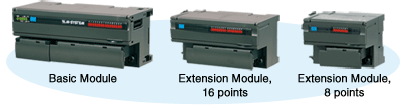
Figure 1. Remote I/O R7 Series External Appearance
 

1. Overview
The R7 Series features a compact module having the power supply, network and I/O sections all in one unit. The R7E provides an ideal wiring saving system using Modbus/TCP protocols over Ethernet with PLCs to efficiently transmit a small number of I/O signals scattered around user’s remote locations.

The basic module can be expanded with an assortment of 8 and 16-point discrete input and output extension modules. This makes it easy to implement a mix of I/O signals to more fully meet the needs of many applications.

2. Features
(1) Compact size

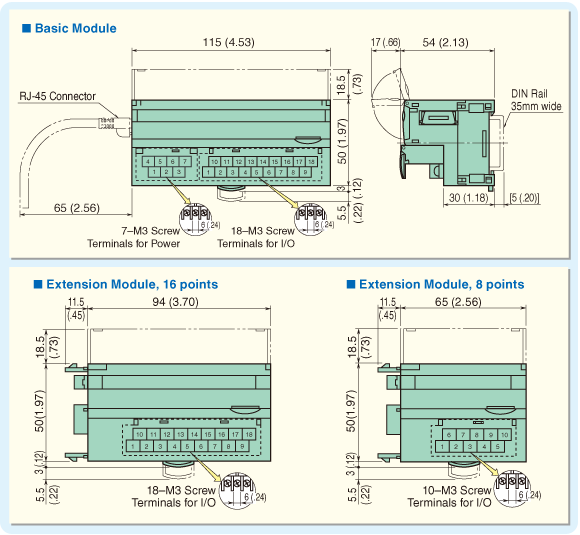
  • Basic module: 115 (W) x 50 (H) x 54 (D) mm (See Figure 2.)
  • Extension module (16 points): 94 (W) x 50 (H) x 54 (D) mm (See Figure 2.)
  • Extension module (8 points): 65 (W) x 50 (H) x 54 (D) mm (See Figure 2.)
 
Figure 2. Modbus/TCP (Ethernet) R7E External Dimensions
 

(2) Expandable discrete I/O
Discrete input and output extension modules can be connected to basic modules. Each basic module can be attached to either an extension contact input module or an extension contact output module. This architecture provides various combinations, such as thermocouple input with discrete input, discrete input with discrete output and others, providing an easy solution for users.
Extension modules are available in both 8 and 16-point types.

(3) Two-piece terminal block
Basic modules use a 2-piece design that allows the power supply terminal and I/O terminal to be separated, providing superior maintainability.

(4) Simple configuration
Input sensor types, input ranges, output ranges are selectable with the DIP switches on the front of the module. Settings of IP address and subnet mask use a PC configurator cable (model: MCN-CON or COP-US) and the PC configurator software (model: R7CON) *. The software simplifies the process by providing a dedicated screen for Ethernet configuration setting.

* PC configurator software (model: R7CON) can be downloaded at M-System’s web site (http://www.m-system.co.jp).

(5) Support for complex applications
Use a different thermocouple for each of the 4 thermocouple input points.
Set a different input range for each of the 4 voltage input points.

Complex configurations, similar to the above mentioned, can be accommodated by using a computer to configure the device with a PC configurator cable and the PC configurator software.

(6) Extensive selection of input ranges
The DC voltage/current input module (model: R7E-SV4) provides 7 DC voltage input ranges and 3 DC current input ranges. Input ranges are configurable utilizing the unit’s DIP switches, thus eliminating the need to obtain numerous module types.

3. Product line
Table 1 lists R7E types.

 
Table 1. Modbus/TCP (Ethernet) R7E Types

BASIC MODULE
Model Points Overview Functionality
R7E-DA16 16 Discrete Input Positive or negative common (NPN/PNP) per 16 points
R7E-DC16A 16 NPN Transistor Output Negative common (NPN) per 16 points
R7E-DC16B 16 PNP Transistor Output Positive common (PNP) per 16 points
R7E-SV4 4 DC Voltage/Current
Input (10V/20mA)
-10 to +10V DC, -5 to +5V DC, -1 to +1V DC,
4 to 20mA DC etc.
R7E-TS4 4 Thermocouple Input Thermocouple: K, E, J, T, B, R, S, C, N, U, L, P, PR
R7E-RS4 4 RTD Input
RTD: Pt 100 (JIS ’97/IEC), Pt 100 (JIS ’89), JPt 100 (JIS ’89),
Pt 50 (JIS ’81), Ni 100, Cu 10, Cu 50
R7E-MS4 4 Potentiometer Input Potentiometer: Total resistance 100Ω to 20kΩ
R7E-CT4E 4 AC Current Input Clamp-on current sensor CLSE use
R7E-YV2 2 DC Voltage Output -10 to +10V DC, -5 to +5V DC, -1 to +1V DC,
-0.5 to +0.5V DC etc.
R7E-YS2 2 DC Current Output 4 to 20mA DC

EXTENSION MODULE
Model Points Overview Functionality
R7E-EA8 8 Discrete Input Positive or negative common (NPN/PNP) per 8 points
R7E-EA16 16 Discrete Input Positive or negative common (NPN/PNP) per 16 points
R7E-EC8A 8 NPN Transistor Output Negative common (NPN) per 8 points
R7E-EC16A 16 NPN Transistor Output Negative common (NPN) per 16 points
R7E-EC8B 8 PNP Transistor Output Positive common (PNP) per 8 points
R7E-EC16B 16 PNP Transistor Output Positive common (PNP) per 16 points
 

4. Panel diagram
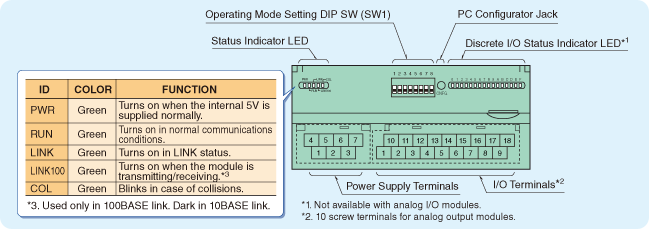
Figure 3 illustrates the R7E’s panel.

 
Figure 3. Modbus/TCP (Ethernet) R7E Front Panel


Application Notes

Physical Vapor Deposition (PVD) is a variety of vacuum deposition and a process by which a thin film of material is deposited on a substrate according to the following sequence of steps: 1) the material to be deposited is converted into vapor by physical means; 2) the vapor is transported across a region of low pressure from its source to the substrate; and 3) the vapor undergoes condensation on the substrate to form the thin film.

PVD covers a number of deposition methods but the two most important technologies are evaporation and sputtering. In VLSI fabrication, the most widely used method of accomplishing PVD of thin films is by sputtering.

Sputtering is a mechanism by which atoms are dislodged from the surface of a material as a result of collision with high-energy particles. Thus, PVD by Sputtering is a term used to refer to a physical vapor deposition (PVD) technique wherein atoms or molecules are ejected from a target material by high-energy particle bombardment so that the ejected atoms or molecules can condense on a substrate as a thin film.Sputtering has become one of the most widely used techniques for depositing various metallic films on wafers, including aluminum, aluminum alloys, platinum, gold, TiW, and tungsten.
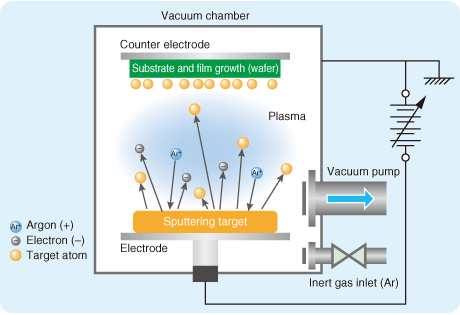
A schematic diagram of a typical RF sputtering system is shown in the figure below.

A schematic diagram of a typical RF sputtering system
 

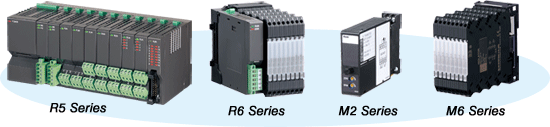
M-System’s full-isolated remote I/O and signal conditioners are widely used to monitor and control the thin film deposition processes:

  • Monitoring of voltage/current at the electrode power source (10 kV / 1 A) in RF sputtering
  • Monitoring of current at the iron beam power source in e-beam sputtering
  • Monitoring of AC current (current transformer input) at the resistance heater in evaporative deposition process
  • Position detection for the servo (pulse input)
  • Position setting for the electronic gun (DC output)
  • Front-end signal conditioning for the remote I/O
  • Signal conditioning for direct input to the PLC


Benefits

  • High isolation capability eliminating interferences by spark noise and superimposed high frequency contents
  • Remote I/O usable with various open networks for PLC benefits the equipment manufacturer for standardization with different of PLCs to suit the end users’ needs
  • Compact, high-density I/O helps the equipment control panel to reduce its footprint

System Configuration Example
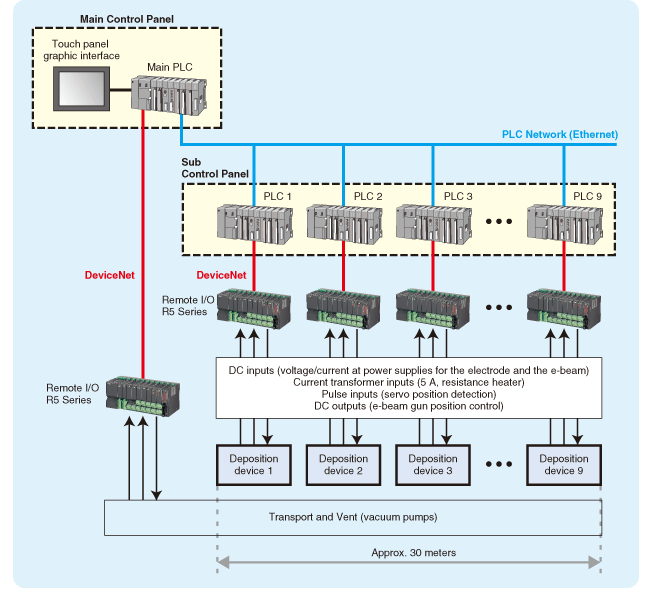
The figure below shows an example of the thin film deposition process control system using a series of vacuum deposition devices. One main PLC provides common control in the system and supervises the nine sub PLCs that control individual vacuum deposition device. All I/O signals are interfaced at the R5 Series remote I/O to the sub PLCs via DeviceNet. The main and sub PLCs are connected via Ethernet. Use of remote I/Os reduces the panel space including that needed for wiring, impacting also the material cost and the work time.

 
System Configuration Example
 

Sputtering Technology is Widely Used in: 

  • Semiconductor industry (integrated circuit processing)
  • Glass surface coatings such as antireflection coating on glass for optical
  • Metal coatings on plastics (aluminized PET film for snack bags, CD and DVDs)
  • Photovoltaic solar cells


Product Information
Lightning Surge Protector for Multi-channel Pulse Signals
Model: MDR2-8
MDR2
 
Data Seet: PDF
 

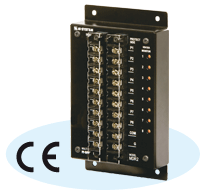
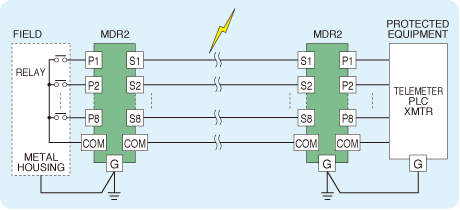
The model MDR2 provides surge protection for semiconductor switches of discrete signals. Eight channels are housed in one package, providing a space-saving and economical solution at the front end of PLCs and field relays. It can be also used for non-isolated analog signals.

LED lights are provided optionally for individual channels to indicate degradation of the voltage limiter, telling the surge protector’s “health.” The LED is powered by the discrete signals without need for an auxiliary power supply.

Compared from the existing model MDR-8, more features have been added:

  • High discharge current capacity 10 kA
  • PNP and NPN types are usable
  • CE marking
  • Tested by IEC 61643-21 (Categories C1, C2)
 
Application Example
 
Specifications MDR2-8 v.s. MDR-8
  MDR2-8 MDR-8
Life monitor Red LED ----
Pulse signal common PNP or NPN NPN
Max. continuous operating voltage Uc
between each line
±30 V ±30 V
Voltage protection level Up
between each line @1 kV/100 A
±40 V
(±50 V with life monitor LED)
±40 V
Voltage protection level Up
between each line @4 kV/2 kA
±60 V ----
Leakage current @max. voltage 5 μA 5 μA
Response time ≤ 4 nanoseconds ≤ 0.1 microsecond
Max. discharge current Imax 10 kA 1 kA
Nominal current IN 150 mA Max. 100 mA
Internal series resistance 22 Ω ±20% Approx. 100 Ω
CE conformity EMC Directive (2004/108/EC)
EN 61000-6-4 (EMI)
EN 61000-6-2 (EMS)
----
Surge protection IEC 61643-1, Categories C1, C2 ----
Operating temperature -5 to +55 °C (23 to 131 °F)
Operating humidity 30 to 90% RH
Dimensions W95 x H160 x D40 mm (3.74” x 6.30” x 0.16”)
Electrical connection M3.5 screws M3 screws


NEW STAFF
Sho Nakajima
Sho Nakajima
 

Hello, everyone. My name is Sho Nakajima. I became a new member of the SE Asia Sales Department and have been covering the Philippine and Vietnam Market since this February. This is a wonderful opportunity for me and I am very pleased to work with you. I would like to introduce myself a bit. I was born in Osaka, a city which is filled with love and laughter all the time. Osakan people are really optimistic and do not hesitate to communicate with people. I recognize myself as such a person, and that personality always helps me to expand my horizons. I have been in China, Singapore and the U.S., and I have communicated with many people. Different countries and different cultures always teach me new things, and I have been moved by those people. With this opportunity, I hope that I can move you as well.

I am looking forward to supporting you, so please let us know anything. M-System is always with you.
Thank you very much.

 
Senka Fujihira
Senka Fujihira
 

Dear sir and madam.
My name is Senka Fujihira. I became a new member of operation group at International sales Department of M-System since April.

I was born in China and came to Japan six years ago. I like Japanese culture very much and I’m getting used to Japanese custom. In Japan, four seasons are clear and beautiful. I like spring in Japan, because in spring Cherry blooms are really beautiful. When you come to Japan, please choose spring. Spring is the best season.

I am a very positive person, and like to communicate with people. Working in operation group at International sales Department is a wonderful opportunity for me. I’ll work very hard. I’m looking forward to working with you. Thank you!


CLIPBOARD is a newsletter from M-System. Introducing new products, product literature and other important information we pick up in our daily business correspondence. Your comments, views and contribution are especially welcome.

M-System Co., Ltd
International Sales Department
Tel: +81-6/6659-8201 Fax: +81-6/6659-8510 Mail:info@m-system.co.jp