Company Profile
 GLOBAL


 Request Info
Points of Caution When Installing Surge Protectors
Grounding
Not only surge protectors, but also computer systems and electronic instruments are connected to the earth grounding to prevent noise interference. Make the crossover wire thick and short to prevent a potential difference built up between the protectorʼs earth terminal and the instrumentʼs earth when the line is subjected by a precipitous rise of lightning surge.
There are reports saying that only one instruments among many has been damaged because this one was left unconnected to the ground with a crossover wire after the connection had been taken out during a regular checkout (Figure 1).
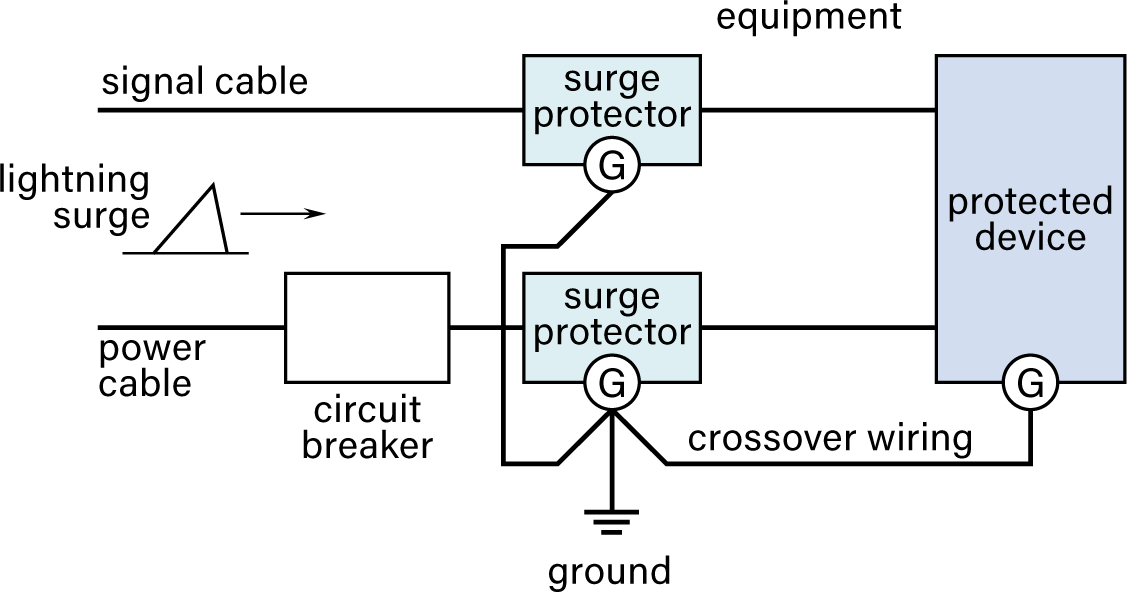
If the protected equipment has no ground terminal, ground the surge protector only.
Insulation test
Before performing the insulation test for an instrument panel equipped with lightning surge protectors, you must disable the surge protectors because they will start discharging during the test and possibly cause insulation failures.
With signal line protectors, simply unplug the element from the base socket.
With power supply line protectors, remove all the grounding wires connected to the ground terminal. Be sure to re-connect all wires back after the test is completed.
Molded-case circuit-breaker
A power supply line protector usually incorporates a circuit protector, however, it may not be able to handle a lightening surge far exceeds its discharge withstand current rating such as direct lightning strike.
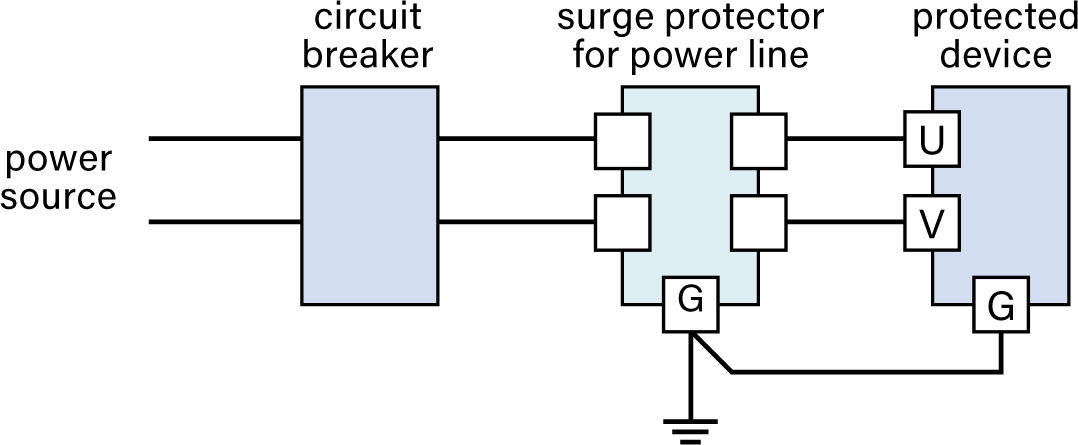
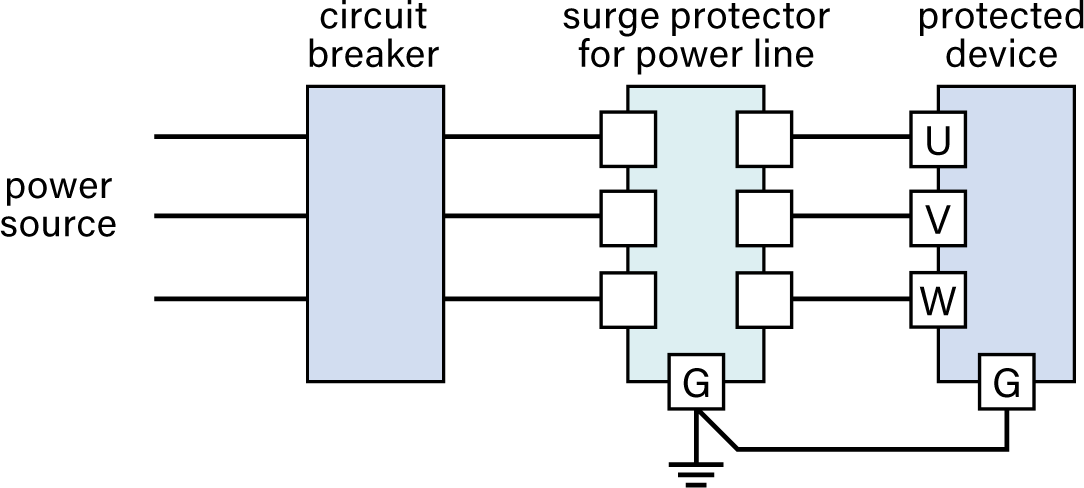
Be sure to set a molded-case circuit breaker. Choose one that its current rating is equivalent to the maximum load current of the surge protector (Figure 2).