Company Profile
 GLOBAL

 Request Info
FAQ for Surge Protectors
Click on the images to enlarge.
Is there a way to protect electronic instrument from a direct lightning strike?
We recommend to use both lightning rod and surge protector at the place where direct lightning might strike.
Discussion
Energy of the direct lightning strike is enormous, only surge protector alone can not protect the instrument. Buildings which lightning might strike should set the lightning rod at the place where building is located in the shield angle. Also, set the overhead grounding wire on the cable. Arrange as most of lightning energy is absorbed by the lightning rod and overhead grounding wire and absorb only the rest by the surge protector.
Lightning rod
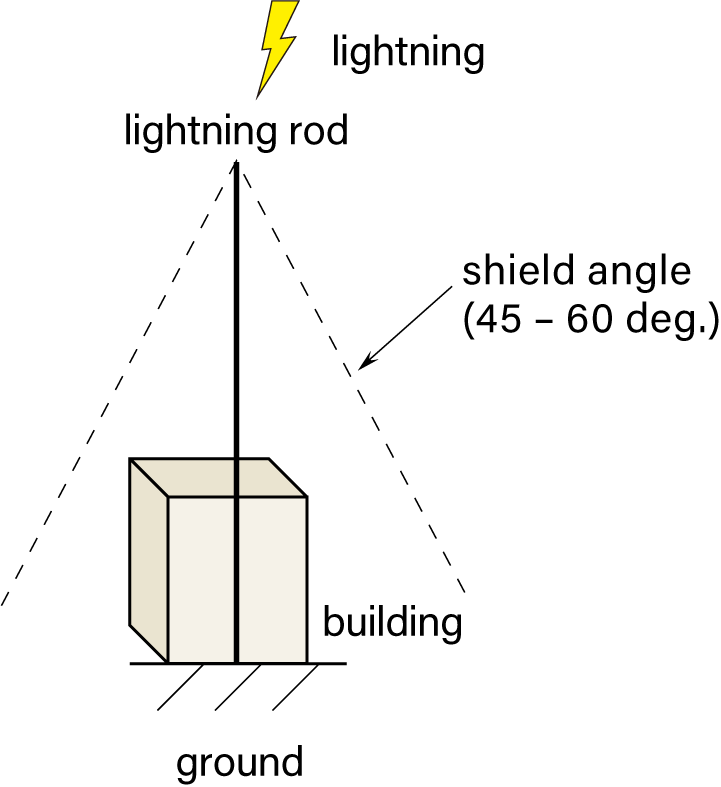
It induces the lightning strike voluntarily and works as the lightning does not strike buildings nearby. The shield angle range is between 45-60 degree conic. Simply burying cables is not effective due to the induced electromotive force that occurs around the cable because of impulse current in the ground near a lightning strike.
Overhead grounding wire
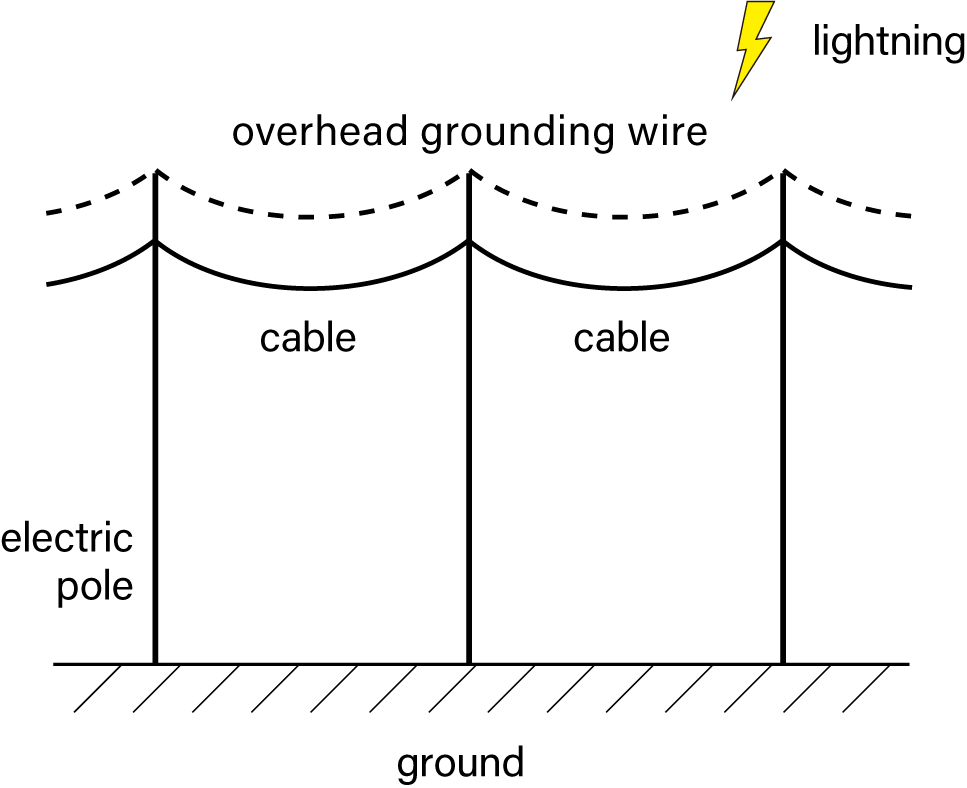
This is a grounding wire which is attached to an overhead transmission line. Its effect is similar to having several lightning rods in a row which shield the lines under them from the lightning strike.
A remote field transmitter connected to a local indicator which is protected by a surge protector begins to show inconsistent display value. What could be the trouble?
It may be time to replace the surge protector due to its lessened capacity, if the problem just started recently.
Each surge protector has a different lifetime. Surge protectors, which have been installed in areas where lightning occurs frequently, should be tested and replaced periodically. Replacing the surge protector with a new one in this instance may solve the problem.
Discussion
Surge protectors can be thought of as consumable items in areas where lightning is common. We would recommend you to periodically check your surge protectors and keep enough replacements on hand for next lightning season. Model C-106A-1 M-Rester Tester can be used to check most surge protectors for proper function.
We have unique lightning surge protectors with life monitoring function. These lightning surge protectors tell us that it is time to change by the monitor lamp or relay contact so you do not need to worry if it is time to change.
A control room instrument was damaged during a recent lightning strike. Why?
If possible, determine exactly where the lightning entered the instrument. In all probability, it entered through the input signal line or power supply line.
We would recommend that you use a surge protector on both the signal and power supply lines. Contact your local sales office for specific models for your application.
Discussion
A transmitter that is attached to a panel located indoors was damaged by a recent lightning strike. Can you explain why this occurred?
Signals and power sources are commonly connected to a transmitter through outdoor cable pits and conduit pipes. It sounds like the lightning surge damaged the transmitter by means of these lines. If the transmitter’s output is sent outdoors, then install surge protectors to protect the input, power and output lines.
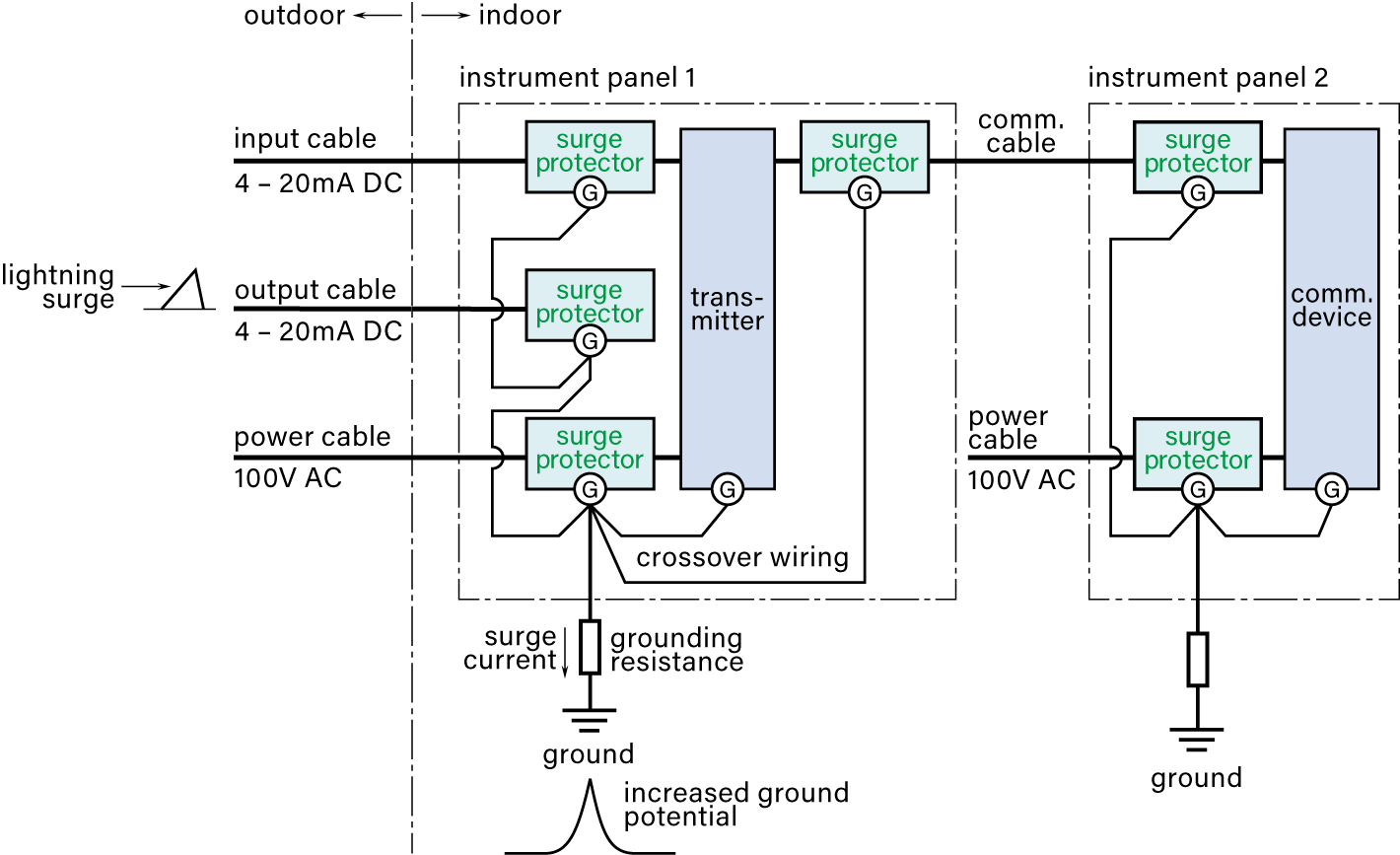
When a panel 1 located indoors works, ground potential for only panel 1 is elevated and it causes potential difference with the panel 2 which is grounded separately at a different place. When panel 1 and 2 are grounded separately, set a surge protector on the cable to connect panels even when it is wired indoors.
Discussion
Is a surge protector necessary for a power supply line?
Yes, spikes and surges often propagate through power lines.
Discussion
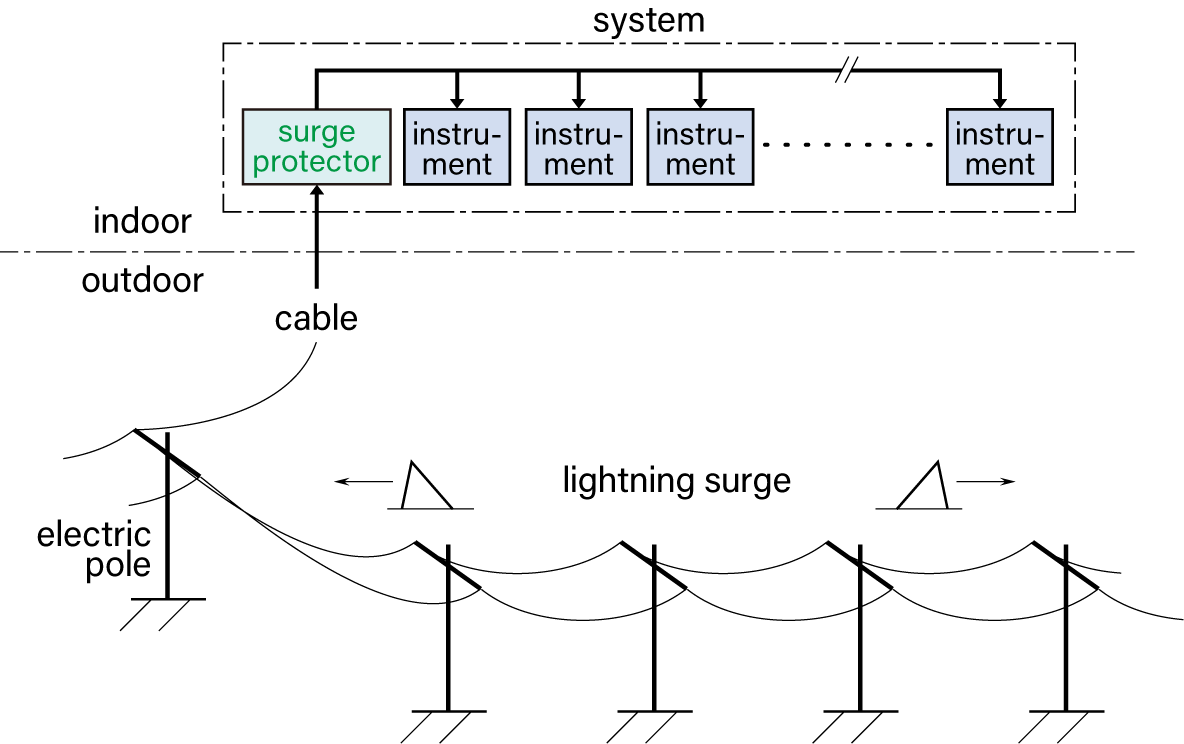
The most likely place for lightning strikes is the power distribution cables. These spread in all directions, like a spider’s web, acting similar to an antenna waiting to receive its signal. Please select the appropriate surge protector for your specific application and power requirements.
Recommended models:
Model |
PowerSupply | Load Capacity |
|---|---|---|
| MA-100 | 100 – 120V AC | 2A |
| MA-200 | 200 – 240V AC | 2A |
| MAX-100 | 100 – 120V AC | 5A |
| MAX-200 | 200 – 240V AC | 5A |
| MMA-100 | 100 – 120V AC | 10A |
| MMA-200 | 200 – 240V AC | 10A |
| MH-105A | 100 – 120V AC | 5A |
| MH-110A | 100 – 120V AC | 10A |
| MH-130A | 100 – 120V AC | 30A |
| MH-205A | 200 – 240V AC | 5A |
| MH-210A | 200 – 240V AC | 10A |
| MH-230A | 200 – 240V AC | 30A |
| MH-1201 | 100 – 120V AC | 200A |
| MH-2201 | 200 – 240V AC | 200A |
| MH-2203 | 200 – 240V AC | 200A |
Is it possible for the surge protector which is set at monitoring panel to protect instrument on the outdoor panel?
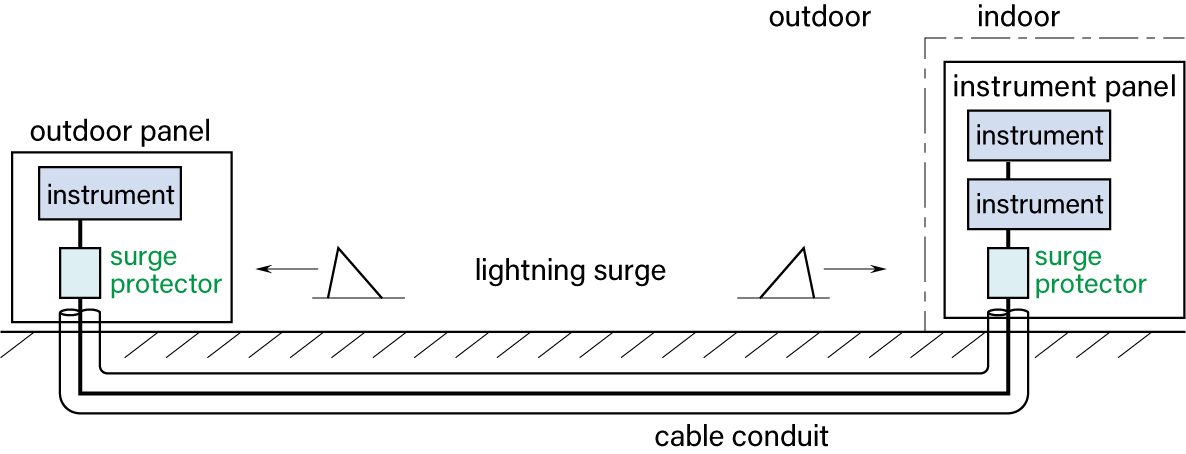
No, it can not protect the instrument. Set a surge protector for the outdoor panel.
Discussion
Surge protector for the cable and for the instrument should be set separately. A surge protector for the instrument can not protect the cable at the same time. Set the same model surge protector for the outdoor panel.
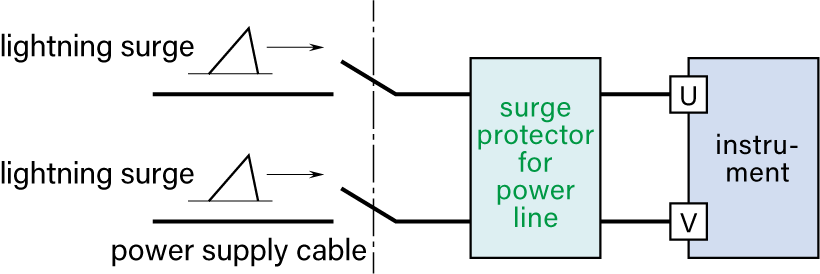
During a recent lightning storm, the power was turned off but some instruments were still damaged. Can you explain this?
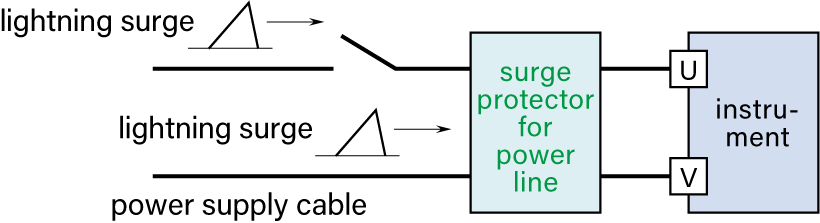
Lightning jumped across the single-pole switch into the instrumentation.
We would recommend to use a double-pole switch. However, this does not insure that a severe lightning surge will not damage. It is depending on the insulation resistance of the switch or the size of the lightening pulse. The only sure solution is to install a surge protector in line with the power source.
Discussion
An instrument was blackened by a lightning strike via a lightning rod. Is there a reason for this?
Because ground potential is elevated, discharge breakdown occurred to the instrument. Set a surge protector. Also, grounding of the lightning rod and surge protector, an instrument, should not be shared but ground individually.
Discussion
When lightning rod is struck by the lightning, high current flows to the ground and voltage at grounding point rises. When instrument panel 1 is within the shield angle, grounding of instrument panel 1 is near the lightning rod and voltage at the grounding of instrument panel 1 becomes high. Therefore, relative electric potential difference is generated between the instrument panel 1 and the instrument panel 2 which is set away from the lightning rod and ground potential is low. Then, discharge breakdown occurs between enclosure of instrument panel and the circuit.
To prevent this to happen, set surge protectors at both instrument panel 1 and 2 and bypass surge current and absorb relative electric potential difference. If the grounding of surge protector and instrument panel 1 are shared, most of the lightning current possibly flows to the surge protector and exceeds discharge withstand current rating. Be sure to set grounding separately.
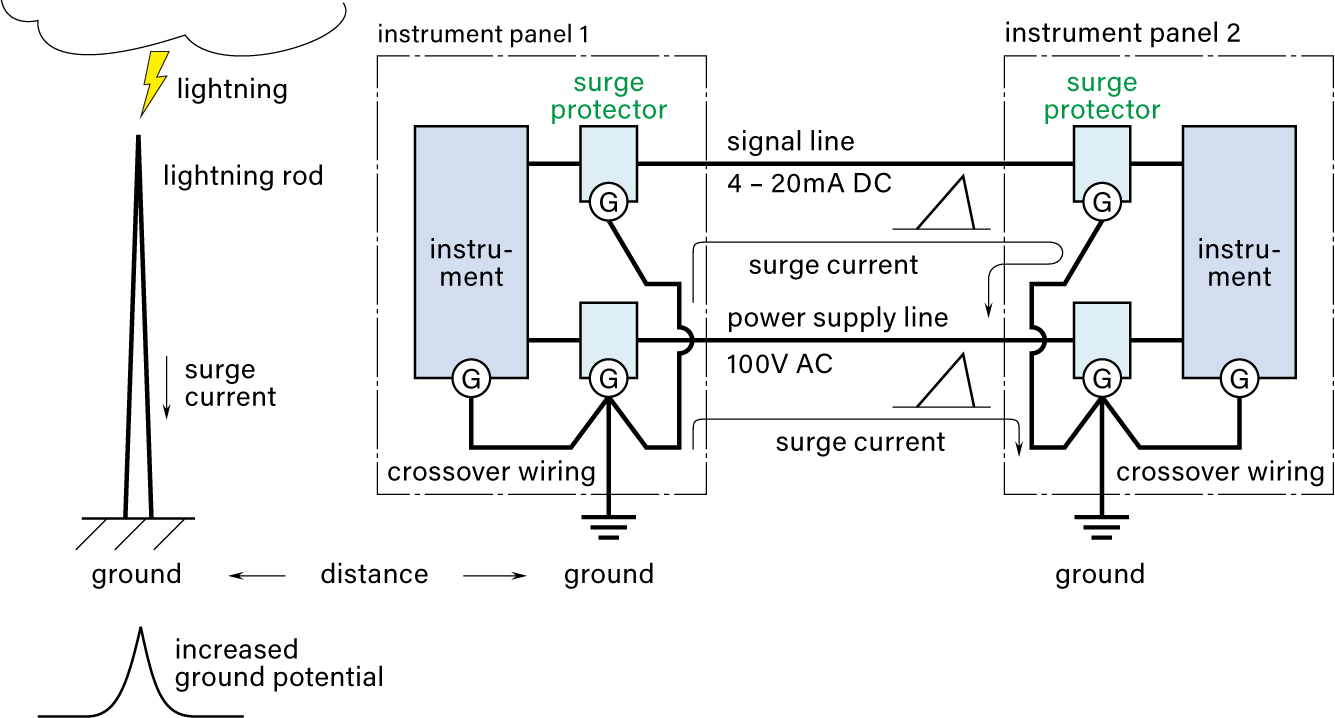
If grounding of surge protectors are shared...
Grounding resistance of surge protector is at least about 1Ω. When lightning current is 200,000A, voltage generated accordingly is 200,000V. If lightning rod and grounding are shared, this voltage flows backward from G terminal and destroy the instrument. Have enough distance separation between them.
It has been said that if you use buried cables, then that is enough from lightning. Is this a true statement?
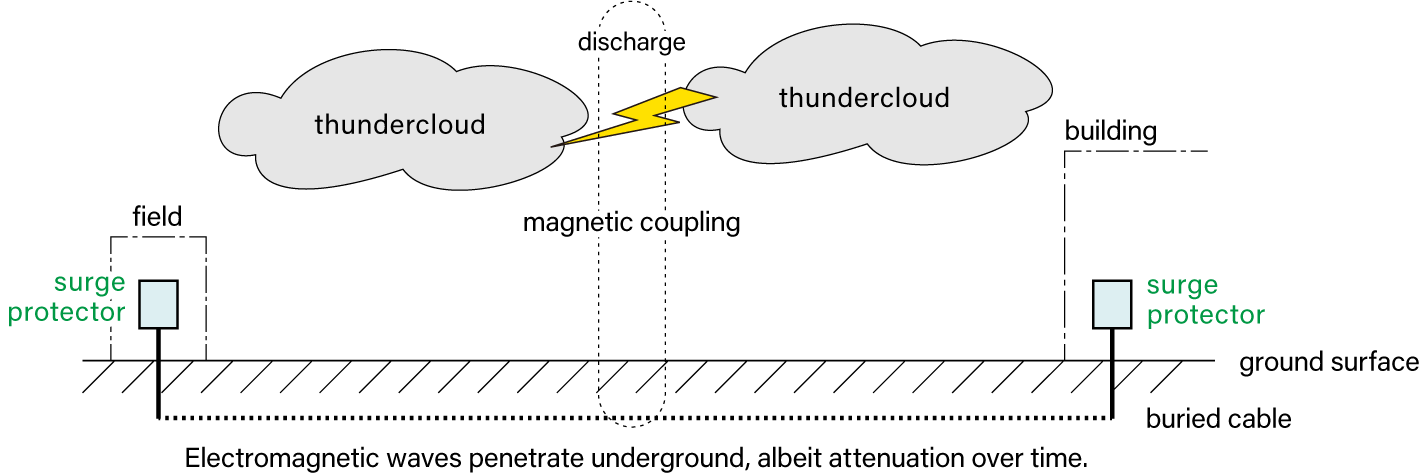
No, because buried cable are also vulnerable to the unpredictable power of lightning.
Discussion
A buried cable does not have as much protection from induced lightning as one might expect, because underground soil easily transmits an electromagnetic field which occurs during a lightning discharge. Also, the high lightning current that is being discharged to ground by the lightning rod can find its way to the buried cables located in the ground.
How much resistance is appropriate when grounding the M-Rester?
As for lightning protection, any grounding is OK. However, for safety reason, D grounding (100Ω) or more is recommended.
Discussion
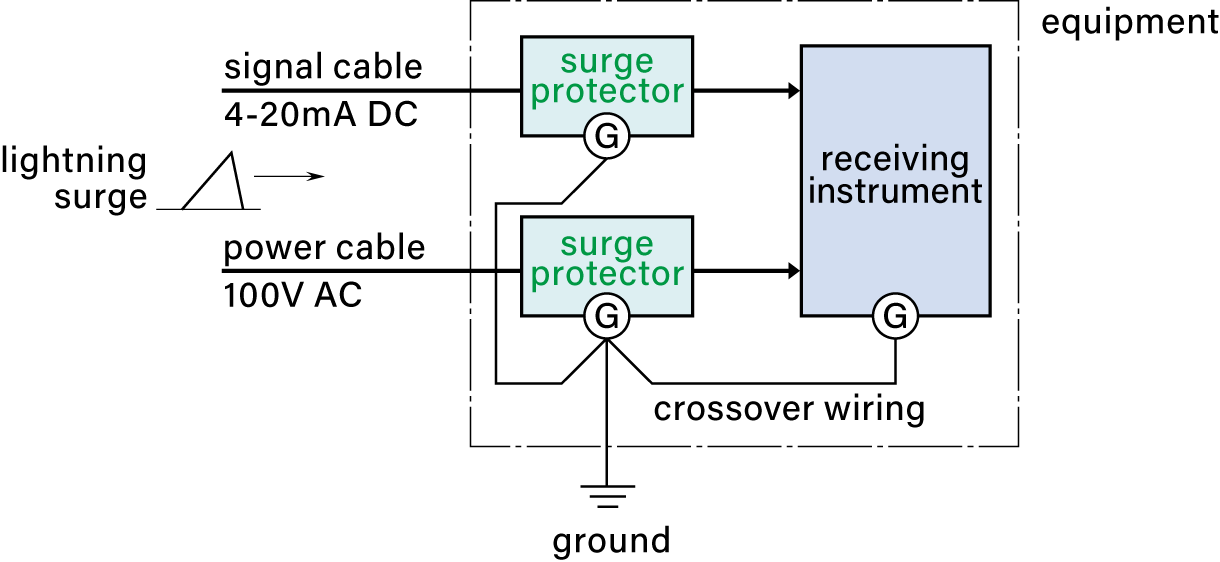
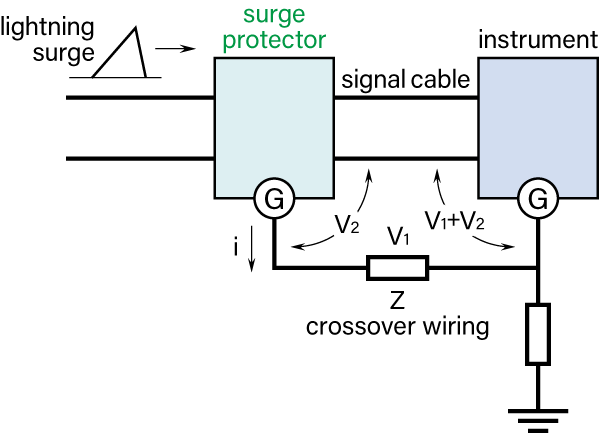
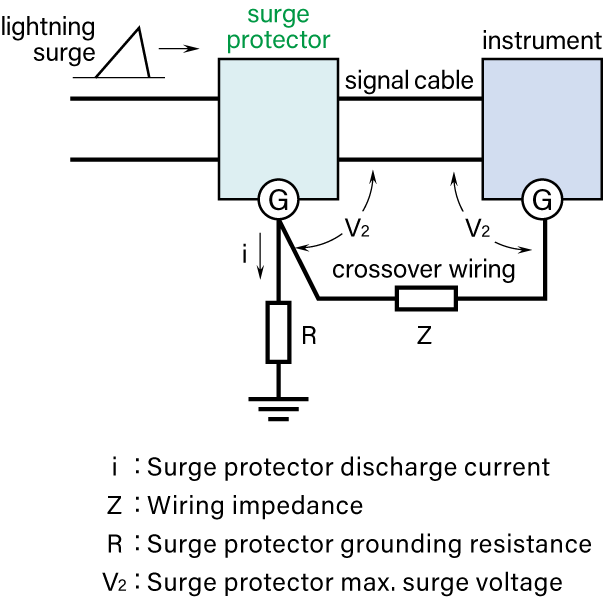
The important thing to remember is that device ground should be connected with a crossover wire. Then ground is at the potential lightning site. As a result, between the signal line and ground terminal (G) of an instrument, discharge voltage (V2) of the surge protector can be added. When appropriate crossover wire is made, instantaneous electric potential is established between the surge protector and the instrument and the volume of the ground resistance does not affect lightning protection function.
Separate wiring
A common-mode voltage V1, ground resistance (R) (lightning surge current (i), is added to discharge voltage V2 at the surge protector between the signal line and a ground terminal of an instrument. In this case, ground resistance need to be very small (less than several ohms). Otherwise, the surge protector does not protect the instrument from the lightning.
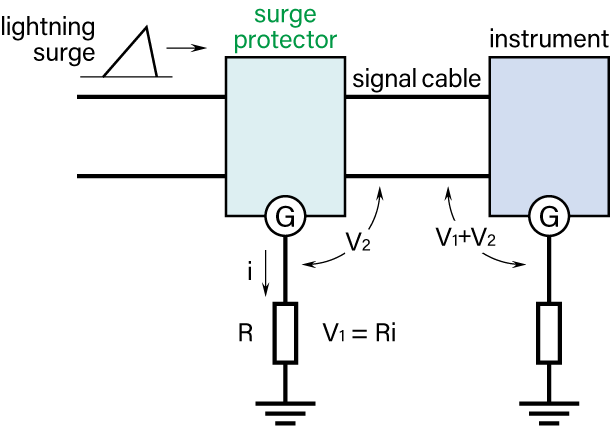
Wiring at instrument site
Because lightning surge current flows in crossover wire, voltage (V1) which figure is calculated by wiring impedance (Z) (lightning surge current (i), join together with clamping voltage (V2) of the surge protector and added to between signal terminal and grounding terminal of the instrument. Lightning protection lessened when crossover wire is long.
Crossover wiring
Because lightning surge current does not flow to crossover wire, only clamping voltage (V2) of the surge protector is added between signal terminal and grounding terminal (G) of the instrument. Full lightning protection of the surge protector is performed.
Is power supply line safe if the surge protector for the power source damaged?
Yes, because the surge protectors have internal protection circuits.
Discussion
There is a chance that incorporated element of the surge protector has closed-circuit failure when the surge protector receives stress from lightning surge for a long time or handle lightning surge that exceeds discharge withstand current rating. At that time, power source line might have short circuit accident or surge protector might have heat accident.
Therefore, surge protectors have a protection circuit that cut off the element. However, it might not be able to handle when a surge protector receives lightning surge which far exceeds discharge withstand current rating such as a direct lightning strike. Be sure to set an electric current breaker on power source line.
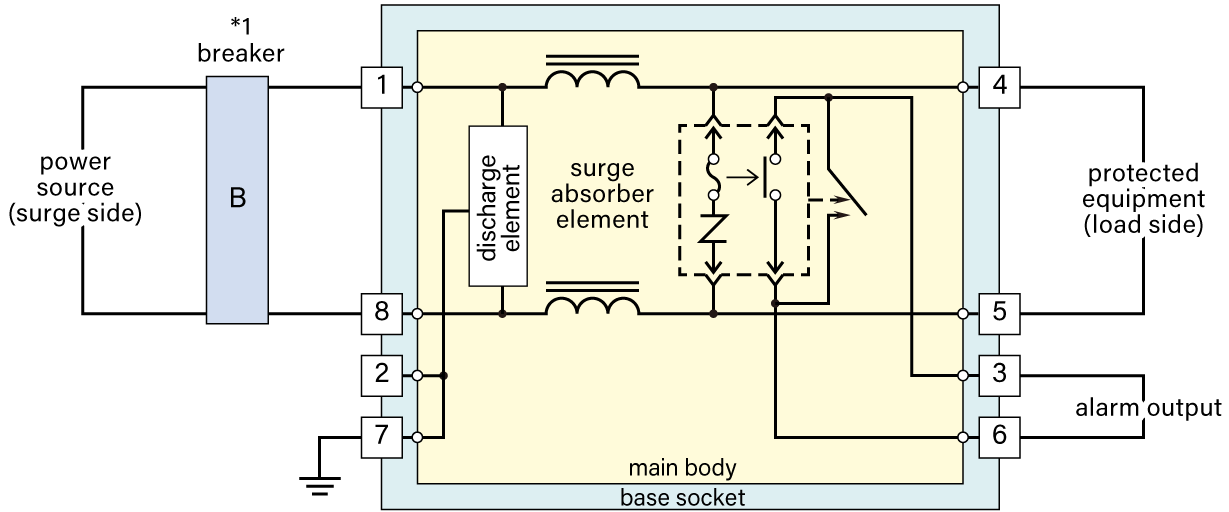
*1. Be sure to install the breaker.
A field transmitter was connected to a surge protector, but it was still damaged by a lightning strike. Can you tell me why?
The surge protector that was selected could be incorrect for that specific application.
Discussion
The maximum surge voltage of a surge protector to be used should be below the withstand voltage of the instrument(s) to be protected. This voltage level could be passed through the surge protector to the instrument(s) during a lightning surge. Be sure to confirm this specification before selecting the surge protector. Damage to protected equipment may occur because of this variable.
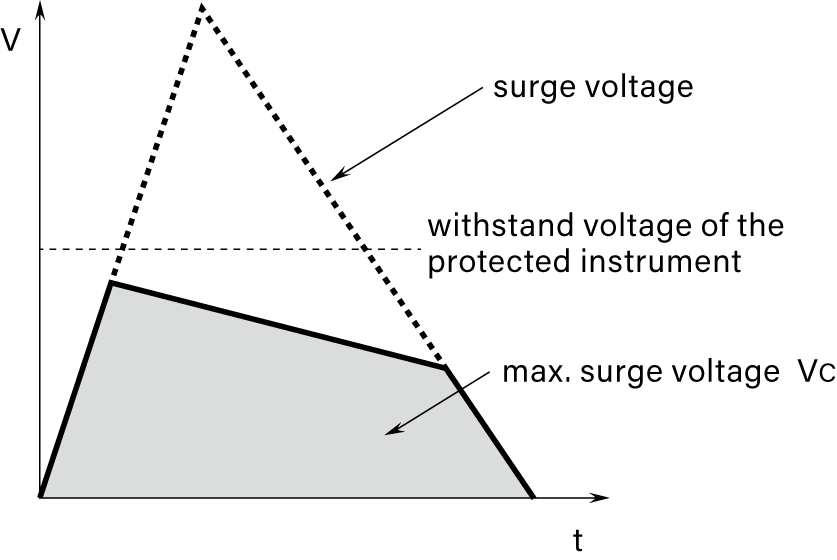
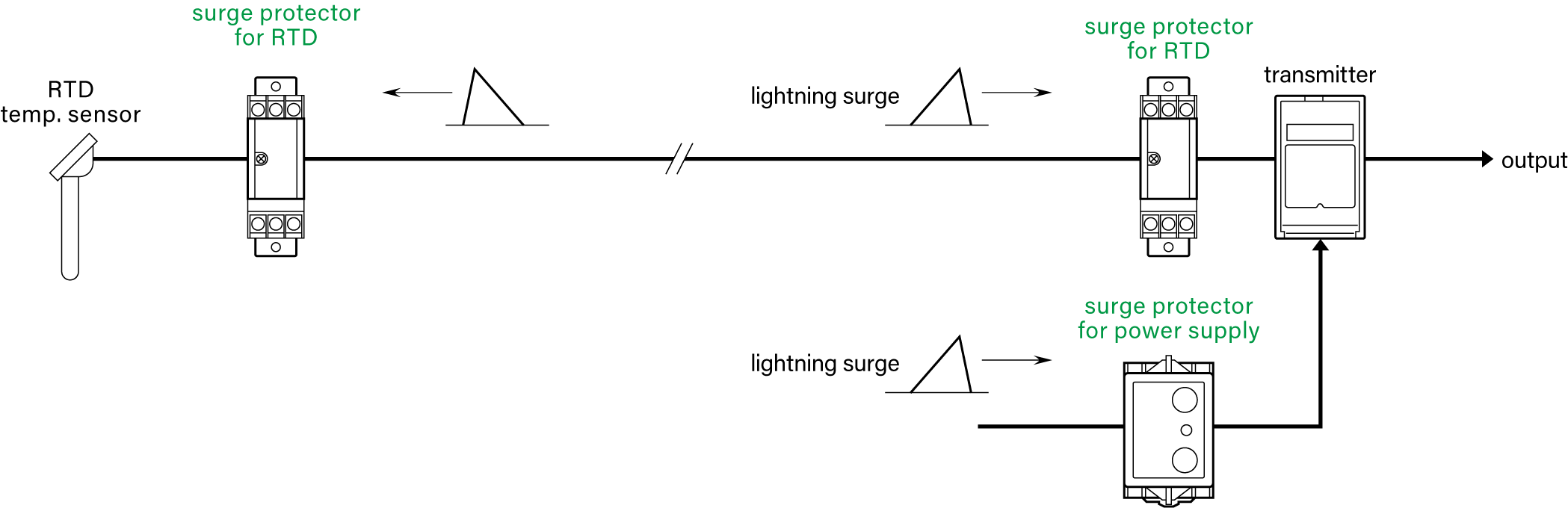
After a lightning storm, there was no input from the remote RTD sensor to the temperature transmitter. There is no detectable damage to the transmitter. What could have happened?
It seems that the RTD temperature sensor was the only device damaged by the lightning.
Discussion
It is recommended that surge protectors be installed on both instrument and RTD to protect RTD sensor. If not, then the temperature transmitter’s output signal could go upscale or downscale if this sensor is destroyed by a lightning surge. This means excessive down time for the process that is being monitored and controlled.